RSS

Sales and new listings slow in August

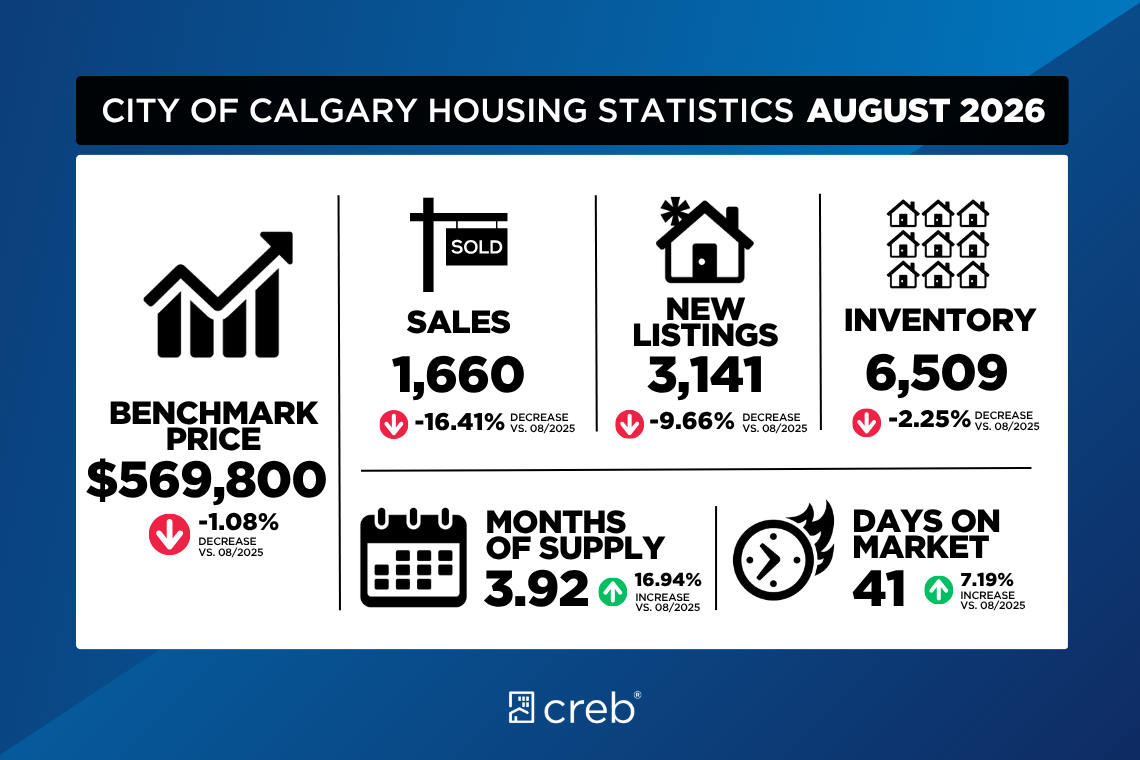
Calgary, Alberta, September 1, 2026 – Consistent with trends throughout most of 2026, both sales activity and the number of new listings coming onto the market have continued to trend down compared with 2025 levels. In August, sales in Calgary were 1,660 units, down 16 per cent compared with last year, while new listings fell by nearly 10 per cent to 3,141 units.

The pullback in sales has not occurred across all price ranges, as homes priced over $1,000,000 have recorded gains over last year. These gains have mostly been driven by detached and semi-detached homes and are also consistent with where most of the supply growth has occurred.

“While sales growth in the upper end of the market was possible thanks to improved supply choice, it also reflects longer-term confidence in our market, as some buyers are not shying away from taking advantage of the available supply,” said Ann-Marie Lurie, Chief Economist at the Calgary Real Estate Board (CREB®). “Meanwhile, we have not seen the same pickup in activity in the lower price ranges, as favourable rental conditions are slowing the transition to ownership.”

Inventory levels in August eased compared with the previous month and the same period last year, at 6,509 units. However, given the pullback in sales, the months of supply pushed up to nearly four months. Also consistent with trends throughout this year, conditions vary significantly by property type, with nearly six months of supply for apartment-style homes compared with over three months of supply for lower-density detached homes.

The relatively balanced conditions in the detached and semi-detached sector have prevented any significant shifts in prices compared with the steady price declines occurring in the oversupplied higher-density segments of the market. As of August, the total residential benchmark price was $569,800, similar to the previous month and one per cent lower than 2025 levels.  
Detached

Gains in higher-priced sales were not enough to offset the pullbacks occurring for homes priced below $1,000,000, as sales fell by 12 per cent to 875 units. At the same time, new listings trended down compared with both July and August 2025 levels, reaching 1,635 units. The steeper decline in sales compared with inventory levels was enough to support a modest monthly gain in inventory levels and drove up the months of supply to over three months. Market balance varies significantly based on price range and location. The months of supply remain below three months in the North West, West, South and South East districts, and above four months in the North and North East districts. The wide range of market balance is also reflected in pricing. Year-over-year gains of over two per cent have occurred in the West and City Centre districts. Meanwhile, price declines were the steepest in the North East at over six per cent. Overall, the benchmark price in August was $744,300, similar to July and down by one per cent compared with last year.

Semi-Detached

Easing sales in August were enough to push year-to-date sales down to 1,516 units, over two per cent lower than last year’s levels. The easing of August sales was not matched by new listings, causing the sales-to-new-listings ratio to fall to 56 per cent. While inventories eased slightly compared with the previous month, they remain nearly five per cent higher than last year. The steeper monthly pullback in sales compared with inventories was enough to push the months of supply above three months, the first time this has happened since January. Despite the shift, conditions remain relatively balanced, and prices have been relatively stable. As of August, the unadjusted benchmark price was $690,500, similar to the previous month and nearly one per cent higher than last year's levels. Price gains in the City Centre, North West and West districts offset pullbacks in other areas, contributing to the annual gain.

Row

Sales continued to ease in August compared with last year, contributing to the year-to-date pullback of 15 per cent. Additional new-home supply, along with more rental product availability, has contributed to some of the pullback in sales activity. Meanwhile, the pullback in new listings has helped prevent any further gains in inventory levels, and the months of supply remained near four months for the second month in a row. Like other sectors, conditions vary depending on location. The months of supply pushed above four months in the City Centre, North East and North districts, while remaining near three months in the West district. Prices have been easing across all districts in the city. The range of decline varied from over 12 per cent in the North East to just over one per cent in the North West district. As of August, the benchmark price was $415,200, down nearly one per cent from July and five per cent lower than levels reported last year at this time.

Apartment Condominium

Apartment-style homes continue to face the most oversupply in the market, with nearly six months of resale supply. More rental supply is weighing on ownership demand from both first-time buyers and investors, which is slowing sales activity while supply levels remain elevated. In August, sales activity continued to fall, contributing to the year-to-date decline of 26 per cent. New listings have also been declining enough to prevent any further inventory gain, but not enough to help the market shift away from buyer-market conditions. Persistently high supply levels relative to demand have weighed on apartment-style prices for the past two years. As of August, the unadjusted benchmark price was $295,400, nearly one per cent lower than the previous month and eight per cent lower than 2025 levels. Prices peaked in August 2024 at $341,300 and currently sit nearly 13 per cent lower than the peak price. 


REGIONAL MARKET FACTS

Airdrie

Sales continued to trend down in August, contributing to the year-to-date decline of 13 per cent. Easing sales have also been met with a seven per cent pullback in new listings over the same period. Throughout most of the year, inventory levels have generally trended higher than last year’s levels and longer-term trends. Over the past few months, we have started to see the pullback in new listings relative to sales cause the sales-to-new-listings ratio to rise, and this has helped prevent any further inventory gains and kept the months of supply below four months. Nonetheless, pressure from competing markets continues to weigh on resale prices. As of August, the unadjusted total residential benchmark price was $508,800, down one per cent from July and over four per cent compared with last year at this time. Steeper price declines are occurring for higher-density apartment-style homes.  
 

Cochrane

Sales improved in August, contributing to the year-to-date gain of over five per cent. Much of the gain in sales has been driven by semi-detached activity. New listings also improved in August compared with last year. The 148 new listings and 94 sales caused the sales-to-new-listings ratio to push above 60 per cent, and inventories edged down compared with the previous month. The boost in sales in August compared with inventory levels caused the months of supply to drop back down to just over three months. Nonetheless, prices still trended down in August. The unadjusted total residential benchmark price eased by nearly one per cent compared with July and is two per cent lower than levels reported last year.  
 

Okotoks

Further declines in new listings likely limited sales activity in August, as the sales-to-new-listings ratio remained elevated at 81 per cent. This contributed to the monthly pullback in inventories, keeping conditions relatively tight with just over two months of supply. Okotoks has struggled with lower-than-average supply levels since 2021, but additional supply choice in competing markets is helping prevent further upward pressure on prices. As of August, the unadjusted total residential benchmark price was $608,400, over one per cent lower compared with July and nearly two per cent lower than last year's levels.
 

Chestermere

The pullback in sales continues to outpace the declines in new listings, as the sales-to-new-listings ratio dropped below 30 per cent in August. This has contributed to elevated inventory levels. While Chestermere is growing, the higher inventory, combined with the pullback in sales, has caused the months of supply to rise, reaching nine months in August. This has continued to weigh on prices, which trended down in August compared with July and currently sit over one per cent lower than 2025 levels.   

Read

Poly-B Plumbing: What Calgary Homeowners Should Really Know

Few words cause as much concern during a home inspection as Poly-B plumbing.

I've seen buyers immediately assume a home is "bad," and I've seen sellers worry their home has suddenly lost all of its value. The truth usually falls somewhere in the middle.

Like many things in real estate, it's important to understand the facts before jumping to conclusions.

What is Poly-B?

Poly-B, short for polybutylene, is a grey plastic plumbing pipe that was commonly installed in Canadian homes from the late 1970s through much of the 1980s and into the 1990s. At the time, it was considered an affordable, flexible alternative to copper and was installed in hundreds of thousands of homes across Canada, including many right here in Calgary.

If your home was built during that period, there's a reasonable chance it contains Poly-B plumbing.

So why does everyone talk about it?

Over time, some Poly-B systems have developed leaks or failures. Research suggests that age, water chemistry, installation practices, and the fittings used all play a role. Not every Poly-B system fails, but enough have experienced issues that it has become something buyers, inspectors and insurance companies pay close attention to.

That doesn't mean every home with Poly-B is destined for problems.

In fact, many Calgary homeowners have lived in homes with Poly-B for decades without ever experiencing a leak. Others choose to replace it proactively during renovations or before selling simply for peace of mind.

The biggest challenge today is often insurance.

For many homeowners, insurance has become a bigger concern than the plumbing itself.

Some insurers may charge higher premiums, require additional documentation, or ask that the plumbing be replaced before offering or renewing coverage. Others continue to insure homes with Poly-B, particularly if there have been no previous issues. Policies vary significantly between insurance companies, which is why it's always worth checking before buying a home.

Should you avoid buying a home with Poly-B?

Not necessarily.

A home should always be evaluated as a whole. Its location, condition, maintenance history, price, and overall value all matter. Poly-B is simply one factor in that equation.

If a home has Poly-B, I recommend:

  • Having a professional home inspection.

  • Confirming insurance options before removing conditions.

  • Obtaining a replacement estimate so you understand the potential future cost.

  • Factoring that information into your buying decision if appropriate.

For many buyers, it's a manageable consideration rather than a deal breaker.

My advice

One of the things I remind clients is that every generation of homes has something buyers ask questions about.

Older homes may have aluminum wiring or asbestos-containing materials. Newer homes may have different concerns altogether. Poly-B simply happens to be one of the common discussion points for homes built during a particular era.

Real estate isn't about finding the perfect house. It's about understanding the home you're buying, knowing what to expect, and making informed decisions with your eyes wide open.

Knowledge is almost always less intimidating than uncertainty, and that's exactly why conversations like this matter.

Read

Price declines driven mostly by apartment condominiums  

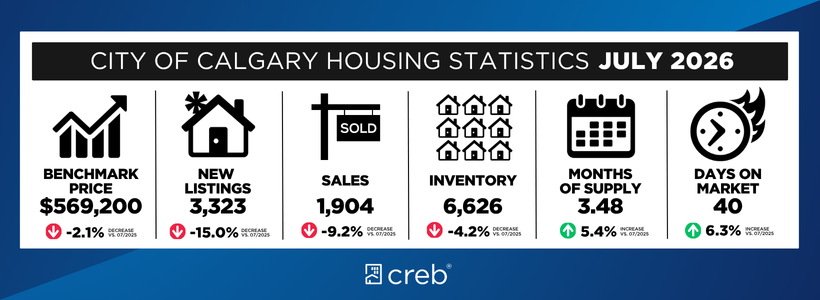
Calgary, Alberta, August 4, 2026 – As we move into the second half of the year, it is not a surprise to see slower market activity. In July, both sales and new listings eased over June levels, declining to 1,904 sales and 3,323 new listings. Sales were nine per cent lower than last year’s levels, while new listings were 15 per cent lower. The adjustment in both sales and new listings caused little change in the sales-to-new-listings ratio, which sat at 57 per cent. 

In July, the unadjusted total residential benchmark price was $569,200, down slightly over June and two per cent lower than levels reported last year. The persistent oversupply of apartment condos is contributing to a steeper price decline of over eight per cent. Meanwhile, at the other end of the spectrum, detached prices have eased by under two per cent compared to last year, mostly driven by adjustments in the North East and North Districts. 

“Several consecutive years of high construction levels and the sudden drop in mostly international migration have contributed to the shift in housing market conditions mostly for higher-density homes, a transition that started in the second half of last year,” said Ann-Marie Lurie, Chief Economist at the Calgary Real Estate Board (CREB®). “While new home construction is slowing, there are over 17,000 apartment-style units under construction. This continues to weigh on rental and higher-density properties, driving price adjustments.”     

While demand has slowed this year, levels remain stronger than those reported during the challenging market conditions experienced from 2015 to 2019. What has shifted significantly is the additional supply choice across the housing spectrum. Total resale inventory levels remained relatively stable compared to both June and July 2025. However, the slower July sales pushed the months of supply up to three and a half months. While the months of supply is rising across all property types, conditions remain mostly balanced in the detached and semi-detached sectors. In the higher-density sectors, the market continues to favour the buyer for apartment-style homes with nearly five months of supply, while row is experiencing some signs of oversupply.

Detached

Sales in July eased to 1,012 units, down nearly two per cent over last year. These numbers have been trending lower throughout most of the year. While slower sales are partly due to changing economic conditions, we have also seen a pullback in the number of new listings. In July, new listings fell to 1,707 units, nine per cent lower than last year, contributing to the year-over-year inventory declines that have persisted since March. The pullback in sales this month outpaced the pullback in inventory levels, causing the months of supply to rise to nearly three months. While this is still in a balanced range, conditions do differ from under two months in the West District to over five months in the North East District. Added competition from the new home market is also weighing on recently built homes listed on the resale market. As of July, the unadjusted detached price in Calgary was $743,900, lower than June and nearly two per cent lower than prices reported last July. While prices have eased over 2025’s peak, it has not erased all the gains reported over the past several years. Price movement has varied significantly across each district. Compared to last year, prices have improved in both City Centre and the West District. The steepest decline occurred in the North East at nearly six per cent. 

Semi-Detached

Despite a typical monthly pullback, sales remained similar to last year, keeping year-to-date levels relatively consistent with 2025. While new listings eased in July, they remain down three per cent so far this year. Throughout most of 2026, conditions have remained relatively balanced, with a sales-to-new-listings ratio remaining near 60 per cent and months of supply below three months. As of July, the unadjusted benchmark price was $691,000, down from June but similar to last year's level. While prices have remained relatively stable for semi-detached homes, there is variation throughout the city. Most sales activity occurred in the City Centre, where year-to-date prices have remained stable compared with 2025. The West District was the only district to record a year-over-year price gain, while the steepest declines occurred in the North East, where buyers' market conditions have emerged. 

Row

For the third consecutive month, row sales have trended down, contributing to a year-to-date decline of 15 per cent. Over the past several months, we have also reported a pullback in new listings, keeping the sales-to-new-listings ratio above 55 per cent.  While inventory levels have also been trending down, they remain elevated based on long-term trends. The steep pullback in sales this month was enough to push the months of supply up to nearly four months. An upward trend in the months of supply over the past few months has prevented any further price increases. In July, the unadjusted benchmark price eased to $418,500, down over the previous month and six per cent lower than last year’s levels. Added competition in the new home market has also weighed on resale row prices. However, like other property types, year-to-date price declines range from 12 per cent in the North East and East Districts to a three per cent decline in the West District. 

Apartment Condominium

Increased rentals and new supply are weighing on ownership demand for resale condos as sales have fallen by nearly 26 per cent so far this year. While new listings have been easing over last year’s levels and are helping to bring down inventory, the 1,999 units available in the resale market are still elevated compared to long-term trends and sales. The combined impact of additional supply and reduced demand has kept the months of supply in a range that has favoured the buyer since the end of spring 2025. The persistent excess supply has placed downward pressure on prices. As of July, the unadjusted benchmark price was $297,600, down over June, over eight per cent lower than last year’s levels and 13 per cent below peak levels reported in 2024. While the rate of decline has ranged across districts, all districts have reported relatively steep adjustments in prices. 


REGIONAL MARKET FACTS

Airdrie

Sales continued to trend down in July compared to 2025, contributing to the year-to-date decline of nearly 14 per cent. However, new listings have also been easing, helping to push the sales-to-new-listings ratio back above 55 per cent in July. While this did little to cause a shift in inventory, the months of supply eased back below four months. Should this trend continue, it will help to support a more balanced state in the Airdrie market. Nonetheless, supply choice in the resale market along with added competition coming from both the new home market in Airdrie and supply choice in Calgary are weighing on prices. Detached prices in July eased to $603,100, four per cent lower than last year’s levels. This decline has outpaced Calgary’s, and now the price spread between Calgary and Airdrie is returning to levels that are more consistent with historical norms.  

Cochrane

While sales have eased for two months in a row, year-to-date, they remain higher than levels reported in 2025. This was partly possible due to gains in new listings, which have raised inventory over last year’s levels. Much of the inventory growth was driven by higher-density homes. In July, the months of supply pushed above four months, and the sales-to-new-listings ratio dropped to 46 per cent. This represents a shift from earlier in the year, and if it persists, it could have further implications for prices. Overall, the unadjusted detached benchmark price was $659,400 in July, down over June and nearly four per cent lower than last year. Like other markets, the added competition from new home products and competing markets is weighing on resale prices.

Okotoks

With 78 new listings and 70 sales in July, the sales-to-new-listings ratio rose to 90 per cent, causing inventories to trend down over the previous month. Supply has improved over the low levels that have persisted over the previous five years but remain below long-term trends and have kept the months of supply relatively low at two months. However, benchmark prices have continued to trend down, likely due to the increased competition coming from the new home sector and new community developments occurring in the south end of Calgary. As of July, the unadjusted detached benchmark price eased to $695,700, over two per cent lower than prices reported last July. 

Chestermere

Year-to-date sales in Chestermere have reached 333 units, 18 per cent lower than last year. The decline in sales has not matched the decline in new listings, keeping the sales-to-new-listings ratio relatively low at 36 per cent. This has resulted in relatively persistent inventory gains, driving up months of supply, which pushed near seven months in July. Additional supply choice in the resale market, competing new home market and supply in Calgary has weighed on prices in Chestermere. As of July, the unadjusted detached benchmark price was $771,900, down over June and nearly five per cent lower than prices reported in July of 2025. 

Read

The Best Parties End in the Kitchen

Every house has that one room. The room everyone is supposed to gather in.

The beautifully decorated living room. The cozy family room. The perfectly styled patio you've spent all week getting ready for guests, and yet, somehow, every single time, everyone ends up in the kitchen.

I've stopped being surprised by it.

People lean against the counters., someone opens a bottle of wine, another person starts helping with dinner, whether they were asked to or not. Before long, there's a crowd gathered around the island, talking about everything and nothing at the same time. Vacation plans. Books they've loved. Kids and grandkids. The latest neighbourhood news. A recipe someone swears you need to try.

The kitchen has a way of making people feel comfortable. It's where conversations happen naturally. Nobody worries about saying the right thing. Nobody is trying to impress anyone. It's just people being together.

As much as I love a beautiful home, I've come to realize that what makes a home special isn't the paint colour, the countertops, or the furniture. It's the life that happens inside it, the laughter that carries from one room to another. The dinners that run long because nobody wants to leave and friends who stay for "just one more drink." It’s the family conversations that somehow solve the world's problems around an island after dessert.

Maybe that's why I've always loved kitchen islands. They're not really about cooking, are they?! They're about connection. In a world that often feels rushed and busy, I think there's something special about having a place where people naturally gather.

So here's to kitchens that are a little crowded, conversations that last longer than expected, and homes that make people want to stay.

After all, the best parties rarely end where they started… they end in the kitchen.

Erika

Read

High-density supply impacts apartment condominium prices

Calgary, Alberta, July 2, 2026 – June sales in Calgary improved over May, reaching 2,197 units. Despite the monthly gains, sales were nearly four per cent lower than last year and just below the long-term average for June, largely due to pullbacks in apartment-style units. While sales are down across most price ranges so far this year, there have been gains in both the highest price ranges and the most affordable ranges across most property types. 

“The easing of demand for resale homes does not come as a surprise given the recent decline in migration, which is impacting both rental and ownership demand for higher-density homes. The bigger change in our market relates to inventory, which has been on the rise in the rental, resale and new-home markets following several consecutive years of record-high housing starts,” said Ann-Marie Lurie, Chief Economist at the Calgary Real Estate Board (CREB®). “Inventory growth has mostly occurred in high-density homes, resulting in buyer’s market conditions and steep price adjustments for condominium apartments. While it will take time to absorb the high-density supply, detached supply growth has been limited and some districts are reporting record-high prices.” 

New listings are starting to pull back compared with 2025 and the sales-to-new-listings ratio rose to 56 per cent. This has slowed the pace of inventory growth in the market and kept the months of supply at just over three months. This is considered a balanced range in the city, but conditions vary across property types. The apartment condominium sector is experiencing buyer’s market conditions, with the months of supply at nearly five months and a sales-to-new-listings ratio of 45 per cent. 

The range of conditions is also impacting prices. In June, the unadjusted benchmark price was $572,500, up over the previous month and two per cent below levels reported last June. However, apartment-style properties have reported an annual decline nearing nine per cent, leaving condominium prices in June at $299,000. Meanwhile, the benchmark price for a detached home rose over the previous month, reaching $750,500, one per cent below last year’s level, with most of the adjustments driven by specific pockets of the market.

Detached

Sales activity in June reached 1,202 units, in line with last year’s levels, as gains for homes priced over $1,000,000 and under $600,000 offset pullbacks in the other price ranges. Sales growth in these segments was partly supported by increases in new listings and inventory growth in those same ranges. While overall inventories have remained in line with last year’s levels and conditions remain relatively balanced, the pullback in new listings this month caused the sales-to-new-listings ratio to rise to 60 per cent. Despite balanced conditions citywide, the North East and East districts are experiencing excess supply relative to demand. In these districts, the months of supply is elevated and the sales-to-new-listings ratio is below 50 per cent. Relatively balanced conditions have supported monthly price gains since the start of the year. It is only the City Centre and West districts that have recorded enough of these gains to reach record-high prices in June. The West district, which has also been experiencing seller’s market conditions, has reported the strongest year-over-year growth at nearly four per cent. Meanwhile, buyer’s market conditions in the North East are contributing to price declines nearing seven per cent. As of June, the citywide benchmark price was $750,500, up over the previous month and over one per cent lower than last year.

Semi-Detached

Improving sales in June were nearly enough to offset earlier pullbacks, leaving year-to-date sales down by only one per cent compared with last year. The 234 sales in June were met with 363 new listings, pushing the sales-to-new-listings ratio back above 60 per cent and slowing the pace of inventory growth compared with earlier in the year. With two and a half months of supply, conditions remained relatively balanced and continued to support stable prices. In June, the unadjusted benchmark was $694,600, up over the previous month and similar to levels reported last June. Similar to the detached sector, price movements vary significantly across the city. Compared with last year, prices have improved in the North West, West and City Centre districts, reaching a new record high in June while the steepest declines occurred in the North East at nearly six per cent.

Row

June saw a pullback in both sales and new listings activity, causing the sales-to-new-listings ratio to rise to 55 per cent. This prevented any further gains in inventory levels, which remain above long-term trends. With 1,152 units in inventory and 338 sales this month, the months of supply sat at nearly three and a half months. While this is higher than both the detached and semi-detached sectors, it remains within the upper end of a balanced range. Additional supply choice has led to price adjustments. Year-over-year declines have occurred across all districts, ranging from two per cent in the South to 10 per cent in both the North East and East districts. Unadjusted prices improved in June over the previous month, as gains in the City Centre, North West and South districts offset pullbacks in the East, North East, West and South East districts.

Apartment Condominium

Sales in June continued to fall compared with last year, causing year-to-date sales to decline by 26 per cent to a total of 2,260 units. While new listings eased this month, the 931 new listings and 423 sales kept the sales-to-new-listings ratio at 45 per cent. In June, inventory levels reached 2,076 units – slightly lower than last June’s level but more than 24 per cent above typical inventory levels. This kept the months of supply at around five months, contributing to further price adjustments. In June, the unadjusted benchmark price was $299,000, down over the previous month and nearly nine per cent lower than last year. Prices have declined across all districts, with decreases exceeding 14 per cent in the North East and East districts. The smallest decline occurred in the North West district at seven and a half per cent.


REGIONAL MARKET FACTS

Airdrie

Sales in June continued to ease compared with last year, contributing to a year-to-date decline of 14 per cent. New listings also eased this month, but with a steeper pullback in sales, the sales-to-new-listings ratio fell to 47 per cent. June inventory levels rose to 538 units. Higher inventory and slower sales pushed the months of supply above four months. Elevated levels of supply in Airdrie, along with increased competition from neighbouring and new home markets, have weighed on resale prices. In June, the unadjusted benchmark price was $516,900, up slightly over the previous month but nearly four per cent lower than last year. Prices declined across all property types, with larger decreases observed in higher-density homes.

Cochrane

Easing sales in June did not offset earlier gains, as year-to-date sales of 569 units were slightly higher than last year’s levels. Meanwhile, new listings also eased, keeping the sales-to-new-listings ratio above 60 per cent. Inventory levels eased slightly from the previous month, reaching 323 units in June. The monthly pullback in inventory did not outpace the pullback in sales, causing the months of supply to push above three months. Despite the increase, relatively tight conditions have supported monthly price gains over the past five months. As of June, the unadjusted benchmark price was $580,200, less than two per cent lower than prices reported at this time last year.

Okotoks

With 89 new listings and 70 sales in June, the sales-to-new-listings ratio rose to 79 per cent, preventing any further monthly gains in inventory levels. Inventory has improved compared with last year but remains below long-term trends, especially for detached homes. While conditions are more balanced compared to last year, lower supply levels have helped keep prices stable. In June, the unadjusted benchmark price was $618,600, similar to the previous month and less than two per cent lower than last June.

Read

Summer in a Bowl

Watermelon, Mint & Feta Salad

There are certain foods that instantly make it feel like summer has arrived, and for me, watermelon is at the top of that list.

Every year, as soon as the weather warms up, I start looking for simple recipes that can be brought to a barbecue, packed for the lake, or enjoyed on the patio after a long day. This watermelon, mint, and feta salad has become one of my favourites because it's refreshing, easy to prepare, and always seems to disappear first.

The sweetness of the watermelon, the saltiness of the feta, and the freshness of the mint somehow work together perfectly. It's one of those recipes that feels a little special despite requiring very little effort.

As a bonus, my mint garden is currently thriving (and threatening to take over), so any recipe that helps me use a handful of fresh mint is a welcome addition to the summer menu.

If you're looking for something light, colourful, and easy to bring to your next gathering, this one is worth adding to your rotation.

Recipe of the Month

Watermelon, Mint & Feta Salad

Ingredients

  • 8 cups watermelon, cubed

  • 1 cup feta cheese, crumbled

  • 1/4 cup fresh mint, chopped

  • 2 tbsp extra virgin olive oil

  • Juice of 1 lime

  • Freshly cracked black pepper, to taste

Instructions

  1. Place the watermelon in a large serving bowl.

  2. Add the crumbled feta, fresh mint, and red onion if using.

  3. Drizzle with olive oil and fresh lime juice.

  4. Gently toss until combined.

  5. Finish with freshly cracked black pepper and serve chilled.

If you're making this ahead of time, wait until just before serving to add the feta and mint. It keeps everything looking fresh and prevents the watermelon from releasing too much juice.

To liven the flavours (and colours) up a little bit more here are some extras you can add that would give just a bit more punch:

  • a handful of blueberries

  • pickled red onions

  • if you’re brave… jalepenos!

Perfect for backyard barbecues, patio dinners, and those evenings when it's simply too hot to turn on the oven.

-Erika 🍉

Read

Why I’ll Always Choose an English Garden

If you've spent any time with me lately, you've probably heard me talk about English gardens.

What started as a few plants here and there has quickly turned into a bit of an obsession. Every time I open Pinterest, visit a garden centre, or walk through an established neighbourhood, I'm looking for ideas and imagining what my own garden could become.

What I love most about an English garden is the balance it strikes between structure and softness. At first glance, they can look almost wild, with flowers spilling over pathways and plants weaving together as though they've simply found their own place to grow. But underneath that relaxed appearance is thoughtful design. Every pathway, shrub, and perennial has a purpose, even if it doesn't immediately reveal itself.

To me, that's what makes them so beautiful. They don't feel overly planned or perfectly manicured. Instead, they feel as though they've evolved over time, growing a little fuller and more beautiful with each passing season.

I also love the elements that seem to get better with age. Weathered stone planters, aged garden gates, rusty trellises, and antique bird baths all develop character as the years pass. Unlike so many things that are replaced the moment they show wear, these pieces become part of the garden's story. The fading paint, the patina, and the imperfections are exactly what make them appealing.

It's never just about the plants, either.

Some of my favourite English gardens include the little details that invite you to slow down and stay awhile. String lights draped through trees, bird feeders attracting visitors throughout the day, climbing vines winding their way over an archway, and quiet corners that feel tucked away from the rest of the world all add to the feeling that the garden is meant to be experienced, not simply admired.

Lately, I've been searching for the perfect spot to place a bench in my own garden. Not because I need another place to sit, but because every English garden seems to have that one destination, a place that encourages you to pause for a few minutes with your morning coffee, a good book, or to watch the kids play with the soccer ball in the yard.

Maybe that's what I love most about these gardens. They aren't created overnight, and they're never truly finished. They change with the seasons, grow a little differently every year, and continually evolve into something more interesting than what was originally planned.

Much like a home, the beauty isn't found in perfection. It's found in the layers, the memories, and the life that unfolds there over time.

Erika

Read

the Mint-uation (… get it?!)

Every spring, I tell myself I'm going to be more practical in my garden.

Then I plant mint.

And every summer, I remember exactly why.

Mint is the overachiever of the herb world. Give it a little sun, a little water, and suddenly you're wondering if you've accidentally started a mint farm. (Trust me, keep it in a pot unless you're looking for a lifelong commitment.)

The best part? It's one of those plants that makes you look far more put together than you actually are.

Friends coming over? Throw some mint in sparkling water and suddenly you're hosting.

Need a quick side dish? Add it to watermelon and feta and people will ask for the recipe.

Want to feel fancy on a Tuesday? Toss a few leaves into a cocktail and call it self-care.

A Few of My Favourite Uses for Fresh Mint

  • Sparkling water, lime, and mint

  • Watermelon, feta, and mint salad

  • Fresh mint tea

  • Homemade simple syrup for cocktails or iced tea

  • Fruit platters that look like you planned ahead

  • Pretty much anything that needs a little summer energy

And speaking of summer energy...

This is one of those recipes that tastes like you spent far more effort than you actually did. My favourite kind.

No complicated ingredients. No kitchen gadgets you'll use once and then store beside the bread maker.

Just a ridiculously refreshing drink that's perfect for patio season.

Blackberry Mint Moscow Mules

This is one of those recipes that tastes like you spent far more effort than you actually did. My favourite kind.

Ingredients

  • 6 oz blackberries

  • ½ cup fresh mint

  • 8 oz vodka

  • 2 oz lime juice

  • 2 sliced limes

  • 12 oz ginger beer

Directions

  1. Muddle the blackberries and mint in a pitcher.

  2. Add the vodka, lime juice, and sliced limes.

  3. Gently stir in the ginger beer.

  4. Pour over ice and garnish with extra blackberries and mint.

So if you've got a mint plant sitting on your deck right now, consider this your sign to stop admiring it and start using it. Your summer drinks, salads, and hosting game will thank you.

And if your mint somehow takes over the entire container by August? Don't worry. That's not a bug. It's a feature.

— Erika 🌿

Read
Data is supplied by Pillar 9™ MLS® System. Pillar 9™ is the owner of the copyright in its MLS®System. Data is deemed reliable but is not guaranteed accurate by Pillar 9™.
The trademarks MLS®, Multiple Listing Service® and the associated logos are owned by The Canadian Real Estate Association (CREA) and identify the quality of services provided by real estate professionals who are members of CREA. Used under license.