
Real Estate Blog
Writing an Offer: There’s More to It Than the Price
Buying a home in Calgary? Learn what goes into a strong offer, including price, deposit, conditions, possession dates and contract terms.
READ POSTStart with what matters to you.

Buying a home in Calgary? Learn what goes into a strong offer, including price, deposit, conditions, possession dates and contract terms.
READ POST
Use Thanksgiving weekend to get your Calgary home ready for winter with this simple fall checklist for maintenance, outdoor cleanup ...
READ POST
Make Thanksgiving cranberry sauce from scratch with fresh cranberries, orange and one special ingredient that gives this classic side ...
READ POST
Learn why Calgary home buyers benefit from choosing one dedicated Realtor instead of working with multiple agents or relying on the ...
READ POST
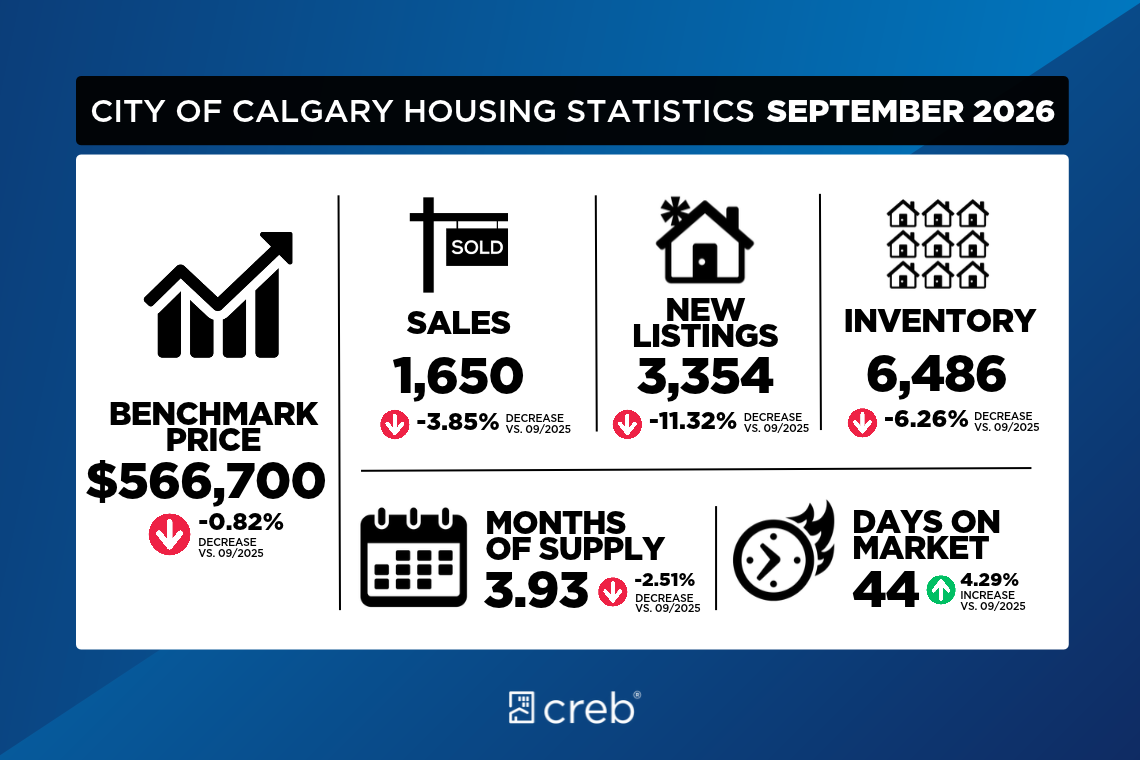
September sales totalled 1,650 units, similar to August and nearly four per cent lower than in September 2025. While September sales typically pull back compared with August, stronger detached home sales helped prevent the typical seasonal pullback.
At the same time, new listings also rose from August, causing the sales-to-new-listings ratio to fall to 49 per cent, leaving inventory levels relatively stable compared with August. Stable sales and inventory levels in September prevented any change in the months of supply compared with August, which remained at just under four months.
While the overall market is showing higher supply levels compared with sales activity, conditions vary significantly by property type. Detached properties remain in balanced territory, and the monthly boost in new listings supported gains in sales in September. Meanwhile, higher supply levels for apartment and row homes are contributing to buyer market conditions, as demand is spread across more alternatives in the rental and new home markets.
“The variation in market conditions between property types is related to where the supply was added. The construction boom over the past three years was mostly driven by gains in higher-density sectors, significantly increasing the supply of apartment and row-style homes,” said Ann-Marie Lurie, Chief Economist at the Calgary Real Estate Board (CREB®). “Meanwhile, detached homes did not see the same boost in construction, preventing broad-based supply growth. Thanks to a stronger job market and slower but positive net migration, housing demand has remained strong enough to absorb some of the supply, but not enough to offset the high-density supply added to the market, resulting in a more significant impact on prices for higher-density homes.”
As the market moves through the fall, it is not unusual to see some unadjusted monthly declines in prices. However, many of these adjustments were seasonal, as seasonally adjusted figures show that prices in September are relatively stable compared with August. The unadjusted residential benchmark price was $566,700, nearly one per cent lower than last year. Most of the price adjustments have occurred in higher-density row and apartment-style units, which have reported year-over-year declines of eight per cent and six per cent in September. Meanwhile, detached prices are one per cent lower than last year, mostly due to declines in the North East, East and North districts.
Sales in September reached 896 units, up from August and more than four per cent higher than last year. The improvement in sales was partly due to a boost in new listings in September compared with August, giving consumers more options. With a sales-to-new-listings ratio of 52 per cent and a months of supply at just over three months, conditions remained relatively balanced. However, conditions have varied across the city, with less than three months of supply in the North West, West and South districts, and nearly six months of supply in the North East district. While the overall market is relatively balanced, the unadjusted benchmark price was one per cent lower than last year. The decline was primarily driven by steep pullbacks in the oversupplied North East district. Meanwhile, prices were higher than last year in both the City Centre and West districts.
The year-over-year gain in sales was not enough to offset earlier declines, as year-to-date sales have declined by two per cent for a total of 1,678 sales. The decline in sales matched year-to-date declines in new listings, but a monthly boost in September listings caused the sales-to-new-listings ratio to dip to 45 per cent, contributing to monthly inventory gains and pushing months of supply to nearly four months. While this is a shift from the tighter conditions reported in this sector throughout most of 2026, it is too early to say whether this will continue into the final quarter. While unadjusted prices did trend down in September, much of the decline was in line with typical seasonal behaviour. The unadjusted September benchmark price was $685,200, comparable to levels reported last year at this time.
Sales in September eased compared with August, while new listings rose, causing the sales-to-new-listings ratio to drop to 45 per cent. This also contributed to higher inventory levels compared with both last year and August, resulting in the months of supply rising above four months for the first time since the beginning of the year. Additional competition from new units has weighed on resale activity, as the price spread between new and resale homes remains relatively narrow. The additional supply choice for buyers has also weighed on row prices, but not to the same extent as in the apartment sector. As of September, the unadjusted benchmark price was $412,400, down nearly six per cent from last year. While prices have declined across all districts, the steepest declines, at more than 11 per cent, have occurred in the North East and East districts, while the smallest declines have occurred in the North West, at two per cent.
Apartment sales improved from August, slowing the year-over-year pace of decline to 14 per cent. New listings also rose over August, with 343 sales and 717 new listings, leaving the sales-to-new-listings ratio at 48 per cent. The monthly gains in sales supported modest reductions in inventory levels and prevented any further increases in the months of supply, which remained just above five months. The excess supply of apartment-style units has weighed on prices throughout most of the year. As of September, the unadjusted benchmark price fell to $291,400, down more than one per cent compared with August and more than eight per cent lower than last September. While some of the monthly decline is seasonal, seasonally adjusted prices continued to decline.
Sales in Airdrie continued to slow in September, contributing to the year-to-date decline of 13 per cent. Sales slowed across all property types, as increased competition from the new home market and competing markets in Calgary and other surrounding areas are weighing on demand. While sales eased in September, new listings also slowed and inventories trended down compared with August. However, the pullback in sales outpaced the inventory declines and the months of supply rose to four months. Additional supply choice continues to weigh on prices as well. As of September, the unadjusted total residential benchmark price was $505,800, nearly four per cent lower than last year. Prices have eased across each property type, with the largest declines occurring for higher-density homes.
Despite the monthly pullback, sales remained higher than last year, and on a year-to-date basis, sales have increased by nearly six per cent. The rise in sales came with an increase in new listings, with new homes accounting for nearly 30 per cent of this year’s total listings. With 163 new listings and 68 sales, the sales-to-new-listings ratio dropped to 42 per cent in September, the lowest monthly level seen since January. This contributed to higher inventory and pushed the months of supply to five months. Despite this one-month shift, prices improved compared with August and are similar to last year’s levels.
An increase in new listings compared with sales caused the sales-to-new-listings ratio to drop to 76 per cent in September, still higher than most other areas, but below the ratios of more than 80 per cent reported over the past two months. With 122 units in inventory and 56 sales, conditions remain relatively tight with just over two months of supply. Despite tighter conditions, increased competition from the new home market and competing markets has weighed on prices earlier this year. However, with an unadjusted total residential benchmark price of $606,800 in September, prices are stable relative to last September and are only one per cent lower on a year-to-date basis.
Sales in September rose, helping to offset some of the gains in new listings. While the sales-to-new-listings ratio remained low at 38 per cent, inventory levels trended down from August and brought the months of supply back below six months. Significant new construction in the area, along with competing supply in Calgary and other surrounding areas, has weighed on prices in Chestermere over the past few months. However, year-to-date prices are only one per cent lower than last year. The unadjusted total residential benchmark price was $690,200 in September, down from August but similar to last year’s levels.


One of my favourite things about summer showings is that buyers aren't just looking at a house—they're imagining their life there.
They're picturing coffee on the deck, kids playing in the backyard, evening barbecues, and quiet nights under the patio lights. Summer has a way of turning buyers into daydreamers, which also means they're noticing things they probably wouldn't in the middle of winter.
In July, your outdoor spaces become an extension of your home.
A tidy lawn, healthy gardens, clean patio furniture, and a welcoming deck all help buyers picture themselves enjoying the space. You don't need a magazine-worthy backyard—you simply want it to feel cared for and inviting.
If you have an evening showing, turning on your outdoor lights can make the space feel even more welcoming.
Nothing distracts buyers faster than walking into a hot house.
If you have air conditioning, make sure it's running before the showing. If you don't, close the blinds during the hottest part of the day and use fans to keep the home comfortable.
While they're inside, buyers are also paying attention to natural light, where the sun hits throughout the day, and whether there are shady spots to enjoy outside. These little details help them imagine what everyday life could look like.
Every season highlights something different about a home, and summer is all about lifestyle.
If your flowers are blooming, let them shine. If your herb garden is thriving, leave it looking its best. Set out a few cushions on the patio furniture and let buyers see how the space is meant to be enjoyed.
You're not just selling a house—you're helping buyers picture the memories they'll make there.
We spend so much of our summer outdoors. Morning coffee on the deck, dinners with friends, backyard games, gardening, and those evenings that seem to last forever.
When buyers walk through your home this time of year, they're looking for a place where those moments can happen. Helping them picture that lifestyle is one of the simplest—and most effective—things you can do before a summer showing.


Every season has its advantages when you're buying a home, but summer offers something many buyers don't always think about.
While spring is often considered the busiest time in real estate, summer gives you the opportunity to see a home in a completely different light, literally. The longer days, warmer weather and active neighbourhoods can reveal things that simply aren't visible during a snowy February showing.
If you're house hunting this summer, don't just focus on the layout and finishes. Take advantage of what the season has to offer.
1. Pay Attention to the Sun
Natural light can completely change how a home feels.
Notice where the morning sun comes in, whether the living room is bright throughout the day, and if the backyard gets evening sun or afternoon shade. If you love entertaining on the deck or spending evenings outside, this can make a bigger difference than you might expect.
2. Picture Yourself in the Backyard
Summer lets you experience outdoor spaces the way they're meant to be enjoyed.
Is there room for kids to play? A garden? A firepit? Does the deck feel private? Can you picture yourself enjoying your morning coffee or hosting friends on a warm evening?
Sometimes buyers fall in love with the backyard just as much as the house.

3. Take in the Landscaping
Mature trees, established gardens and thoughtful landscaping are all on full display this time of year.
Not only do they add curb appeal, but they can also provide privacy, shade and value that would take years, and a significant investment, to recreate.
4. Get a Feel for the Neighbourhood
One of my favourite parts of summer showings is that the neighbourhood comes alive.
Families are outside, people are walking their dogs, kids are riding bikes and neighbours are chatting over the fence. It's the perfect opportunity to ask yourself, Can I picture myself living here?
You'll also notice things like traffic patterns, nearby parks and how busy, or quiet, the street really is.
5. See How the Home Handles the Heat
If it's a warm day, pay attention to how comfortable the home feels.
Does it have air conditioning? If not, does it stay naturally cool? Are the upstairs bedrooms noticeably warmer? Do the windows allow for good airflow?
These are questions that rarely come up during a winter showing but can make a big difference once you've moved in.

Summer is a great time to simply pause for a minute.
Open a patio door or stand in the backyard and listen. Can you hear traffic? Is there a nearby playground? Do you notice train noise, busy roads or barking dogs?
These aren't necessarily deal-breakers, but they're details you'll appreciate knowing before you write an offer.
7. Look Beyond the House
Take a few extra minutes to explore the surrounding area.
Walk to the nearest park, check out nearby pathways or drive through the community after your showing. Buying a home isn't just about the property—it's about the lifestyle that comes with it.

It's easy to picture where your furniture will go. It's even better to picture where life will happen.
Can you imagine a backyard barbecue with friends? Watching the kids play outside? Reading a book on the deck after work? Growing tomatoes in the garden?
Sometimes those little moments are what turn a house into a home.
Buying a home is about more than square footage and finishes. It's about finding a place that fits the way you want to live.
If you're still in the early stages of your search, take some time to explore Calgary homes for sale on my website. You can create a free account, save your favourite properties, set up custom searches and receive new listings that match exactly what you're looking for—all in one place.
Whether you're planning to buy this summer or simply starting to explore what's available, taking the time to notice these details now can help you make a more confident decision when the right home comes along.

Calgary, Alberta, July 2, 2026 – June sales in Calgary improved over May, reaching 2,197 units. Despite the monthly gains, sales were nearly four per cent lower than last year and just below the long-term average for June, largely due to pullbacks in apartment-style units. While sales are down across most price ranges so far this year, there have been gains in both the highest price ranges and the most affordable ranges across most property types.
“The easing of demand for resale homes does not come as a surprise given the recent decline in migration, which is impacting both rental and ownership demand for higher-density homes. The bigger change in our market relates to inventory, which has been on the rise in the rental, resale and new-home markets following several consecutive years of record-high housing starts,” said Ann-Marie Lurie, Chief Economist at the Calgary Real Estate Board (CREB®). “Inventory growth has mostly occurred in high-density homes, resulting in buyer’s market conditions and steep price adjustments for condominium apartments. While it will take time to absorb the high-density supply, detached supply growth has been limited and some districts are reporting record-high prices.”
New listings are starting to pull back compared with 2025 and the sales-to-new-listings ratio rose to 56 per cent. This has slowed the pace of inventory growth in the market and kept the months of supply at just over three months. This is considered a balanced range in the city, but conditions vary across property types. The apartment condominium sector is experiencing buyer’s market conditions, with the months of supply at nearly five months and a sales-to-new-listings ratio of 45 per cent.
The range of conditions is also impacting prices. In June, the unadjusted benchmark price was $572,500, up over the previous month and two per cent below levels reported last June. However, apartment-style properties have reported an annual decline nearing nine per cent, leaving condominium prices in June at $299,000. Meanwhile, the benchmark price for a detached home rose over the previous month, reaching $750,500, one per cent below last year’s level, with most of the adjustments driven by specific pockets of the market.

Sales activity in June reached 1,202 units, in line with last year’s levels, as gains for homes priced over $1,000,000 and under $600,000 offset pullbacks in the other price ranges. Sales growth in these segments was partly supported by increases in new listings and inventory growth in those same ranges. While overall inventories have remained in line with last year’s levels and conditions remain relatively balanced, the pullback in new listings this month caused the sales-to-new-listings ratio to rise to 60 per cent. Despite balanced conditions citywide, the North East and East districts are experiencing excess supply relative to demand. In these districts, the months of supply is elevated and the sales-to-new-listings ratio is below 50 per cent. Relatively balanced conditions have supported monthly price gains since the start of the year. It is only the City Centre and West districts that have recorded enough of these gains to reach record-high prices in June. The West district, which has also been experiencing seller’s market conditions, has reported the strongest year-over-year growth at nearly four per cent. Meanwhile, buyer’s market conditions in the North East are contributing to price declines nearing seven per cent. As of June, the citywide benchmark price was $750,500, up over the previous month and over one per cent lower than last year.
Improving sales in June were nearly enough to offset earlier pullbacks, leaving year-to-date sales down by only one per cent compared with last year. The 234 sales in June were met with 363 new listings, pushing the sales-to-new-listings ratio back above 60 per cent and slowing the pace of inventory growth compared with earlier in the year. With two and a half months of supply, conditions remained relatively balanced and continued to support stable prices. In June, the unadjusted benchmark was $694,600, up over the previous month and similar to levels reported last June. Similar to the detached sector, price movements vary significantly across the city. Compared with last year, prices have improved in the North West, West and City Centre districts, reaching a new record high in June while the steepest declines occurred in the North East at nearly six per cent.
June saw a pullback in both sales and new listings activity, causing the sales-to-new-listings ratio to rise to 55 per cent. This prevented any further gains in inventory levels, which remain above long-term trends. With 1,152 units in inventory and 338 sales this month, the months of supply sat at nearly three and a half months. While this is higher than both the detached and semi-detached sectors, it remains within the upper end of a balanced range. Additional supply choice has led to price adjustments. Year-over-year declines have occurred across all districts, ranging from two per cent in the South to 10 per cent in both the North East and East districts. Unadjusted prices improved in June over the previous month, as gains in the City Centre, North West and South districts offset pullbacks in the East, North East, West and South East districts.
Sales in June continued to fall compared with last year, causing year-to-date sales to decline by 26 per cent to a total of 2,260 units. While new listings eased this month, the 931 new listings and 423 sales kept the sales-to-new-listings ratio at 45 per cent. In June, inventory levels reached 2,076 units – slightly lower than last June’s level but more than 24 per cent above typical inventory levels. This kept the months of supply at around five months, contributing to further price adjustments. In June, the unadjusted benchmark price was $299,000, down over the previous month and nearly nine per cent lower than last year. Prices have declined across all districts, with decreases exceeding 14 per cent in the North East and East districts. The smallest decline occurred in the North West district at seven and a half per cent.
Sales in June continued to ease compared with last year, contributing to a year-to-date decline of 14 per cent. New listings also eased this month, but with a steeper pullback in sales, the sales-to-new-listings ratio fell to 47 per cent. June inventory levels rose to 538 units. Higher inventory and slower sales pushed the months of supply above four months. Elevated levels of supply in Airdrie, along with increased competition from neighbouring and new home markets, have weighed on resale prices. In June, the unadjusted benchmark price was $516,900, up slightly over the previous month but nearly four per cent lower than last year. Prices declined across all property types, with larger decreases observed in higher-density homes.
Easing sales in June did not offset earlier gains, as year-to-date sales of 569 units were slightly higher than last year’s levels. Meanwhile, new listings also eased, keeping the sales-to-new-listings ratio above 60 per cent. Inventory levels eased slightly from the previous month, reaching 323 units in June. The monthly pullback in inventory did not outpace the pullback in sales, causing the months of supply to push above three months. Despite the increase, relatively tight conditions have supported monthly price gains over the past five months. As of June, the unadjusted benchmark price was $580,200, less than two per cent lower than prices reported at this time last year.
With 89 new listings and 70 sales in June, the sales-to-new-listings ratio rose to 79 per cent, preventing any further monthly gains in inventory levels. Inventory has improved compared with last year but remains below long-term trends, especially for detached homes. While conditions are more balanced compared to last year, lower supply levels have helped keep prices stable. In June, the unadjusted benchmark price was $618,600, similar to the previous month and less than two per cent lower than last June.


If you've ever thought about selling your home during the summer, chances are someone has told you to wait until spring. After all, the kids are out of school, vacation plans are in full swing, and if you're lucky enough to live in Calgary, the mountains, lakes and patios tend to pull our attention away from just about everything else. It feels logical that the housing market would slow down too.
But here's the thing: real estate doesn't stop in the summer. It simply changes.
The spring market often gets most of the attention, which has created the perception that it's the only "good" time to sell. While spring is certainly busy, summer continues to bring buyers into the market, and many of them have a reason they can't wait until September. People are still being transferred for work. Families are trying to move before the next school year begins. Some homeowners have already sold and need to find their next home. Others want to get settled before winter arrives.
The buyer pool may be a little smaller than it is in April or May, but the buyers who are actively looking in July and August are often highly motivated. They're not browsing for fun. They're looking because they need to make a move.
One of the biggest advantages of selling a home in summer is something many homeowners overlook: less competition. Spring brings a flood of new listings to the market. By mid-summer, many of those homes have already sold, and inventory often begins to shrink. That means buyers have fewer options to choose from. A well-prepared, well-marketed home can sometimes stand out more in July than it would have during the busiest weeks of spring.
Summer also happens to be one of the best seasons for showing off a property. Lawns are green. Gardens are blooming. Trees are full. Patios, decks and outdoor living spaces are being used exactly as they were intended. Longer daylight hours make it easier to schedule showings and allow homes to feel brighter and more inviting.
In a city like Calgary, where we spend so much of the year looking forward to summer, buyers aren't just purchasing a house. They're buying a lifestyle. They're picturing morning coffee on the deck, evenings around the fire table, and backyard barbecues with friends and family. That emotional connection can be a powerful part of the selling process.
Now, does summer have its challenges? Of course. Showings can be a little less predictable. Some buyers will be away on vacation. Weekend activity may fluctuate depending on long weekends, travel plans or the weather. But serious buyers remain serious buyers.
In my experience, the season itself is rarely the deciding factor in whether a home sells successfully. Pricing, presentation and marketing matter far more than the month on the calendar. A home that's priced correctly and marketed effectively in July will almost always outperform an overpriced home listed in April.
Which brings me to something I tell clients often: there isn't a perfect time to sell a home. There's a right time for your life.
Whether that's spring, summer, fall or winter, the best time to make a move is when it aligns with your goals, your timeline and what's happening in your world. The market will always have its seasonal rhythms. Life doesn't always wait for them… and sometimes, summer is exactly the right time to make your move.
Thinking about selling your home in Calgary this summer? I'd be happy to talk through your options, answer your questions, and help you decide whether the timing makes sense for you—without any pressure and on your timeline.
See you around the kitchen island,
Erika