Calgary Market Updates

CALGARY REAL ESTATE

What's changing in Calgary real estate and what it means for buyers and sellers.

Latest Blog Posts

From My Kitchen: Cranberry, Orange & Pistachio Biscotti
Around the Kitchen Island

From My Kitchen: Cranberry, Orange & Pistachio Biscotti

Make festive cranberry, orange and pistachio biscotti with this easy homemade recipe. Perfect for Christmas baking, holiday gifts and ...

READ POST
The Pre-Christmas Declutter: Five Spaces Worth Tackling Now
Around the Kitchen Island

The Pre-Christmas Declutter: Five Spaces Worth Tackling Now

Get your home ready for the holidays with five simple spaces to declutter before Christmas. Practical organizing tips for a less stressful December.

READ POST
Who’s Involved When You Buy a Home in Calgary?
Real Estate Blog

Who’s Involved When You Buy a Home in Calgary?

Buying a home in Calgary involves more than a buyer and seller. Learn what your Realtor, mortgage professional, lawyer, inspector and ...

READ POST
Should You Buy or Sell First?
Real Estate Blog

Should You Buy or Sell First?

Should you buy your next home before selling your current one? Learn the pros, risks and timing considerations for Calgary homeowners planning a move.

READ POST
RSS

Calgary Real Estate Market Update: October 2026

Supply Levels ease as we move into winter

More choice for buyers, but not every Calgary neighbourhood is experiencing the same market.

If you've been following Calgary's real estate market this year, you've probably noticed that things feel a little different than they did a year or two ago. Homes aren't necessarily selling as quickly, buyers have more options to consider, and pricing has become an increasingly important part of the conversation.

But one thing I think is especially important to understand is that there isn't just one Calgary real estate market. What's happening with detached homes in one neighbourhood can look very different from what's happening with apartment-style condos somewhere else.

October's numbers are a good reminder of exactly that.

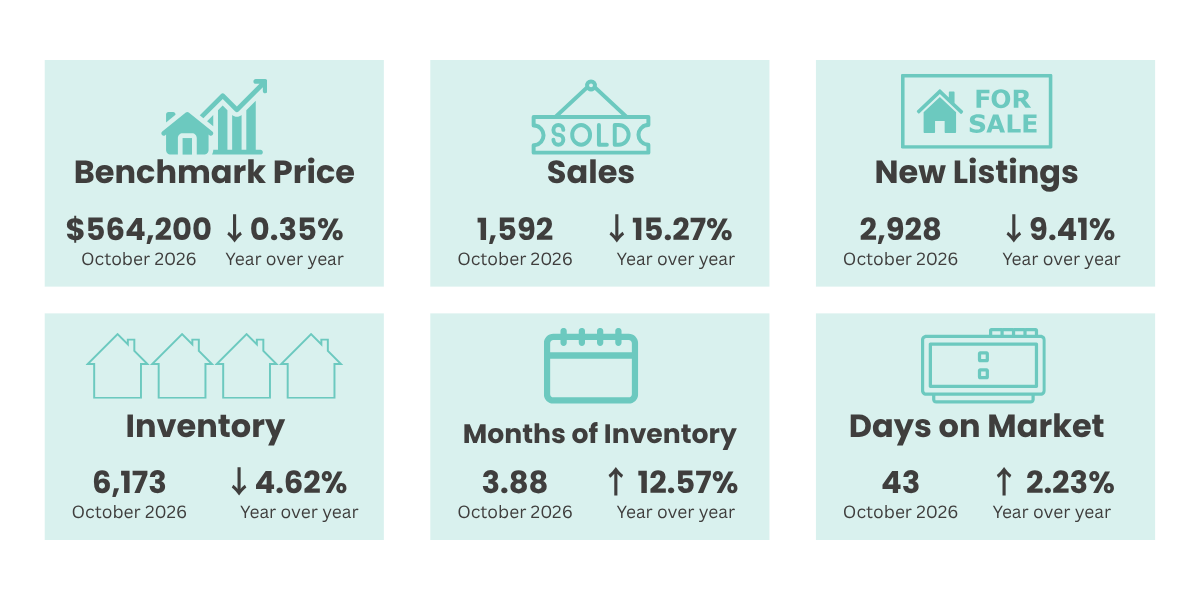
Calgary's October 2026 Market at a Glance

Compared with October 2025, sales were down approximately 15%, while new listings declined just over 9%. The benchmark price was relatively stable year over year, sitting less than 1% below last October.

More Choice Doesn't Mean Every Home Is Easier to Buy

One of the biggest changes we've seen throughout 2026 is the amount of choice available to buyers, particularly in the apartment and townhouse markets.

When buyers have more properties to compare, they often have more time to make decisions and greater opportunities to negotiate. That's a welcome change for anyone who remembers how competitive Calgary's market felt not that long ago.

Detached homes, however, have generally maintained more balanced conditions. Depending on the neighbourhood, price point and condition of the property, well-priced homes can still attract meaningful interest.

That's why I always encourage buyers and sellers to look beyond the citywide headlines. A market statistic is a useful starting point, but it doesn't tell the whole story.

What Does This Mean If You're Selling?

If you're thinking about selling, I believe preparation and pricing matter more than ever.

A couple of years ago, limited inventory sometimes meant buyers were willing to overlook things they might otherwise have questioned. With more choice available today, they're comparing properties more carefully. They're paying attention to condition, location, updates and how a home is priced relative to the competition.

That doesn't mean you need to renovate your entire home before listing or automatically price below your expectations. It means understanding your competition and making thoughtful decisions before your property goes on the market.

The goal isn't simply to attract attention. It's to attract the right buyer at a price that makes sense.

What Does This Mean If You're Buying?

For buyers, the additional inventory in some segments is creating opportunities we haven't seen in quite some time.

You may have more room to explore different neighbourhoods, compare properties and negotiate conditions that help you feel comfortable with your purchase.

That said, I wouldn't assume every listing is negotiable or that waiting will necessarily lead to a better opportunity. The right strategy depends on the property you're considering and the competition surrounding it.

My Take on Calgary's Market

If there's one thing I'd like people to take away from October's report, it's that broad market headlines don't always reflect what's happening in your own backyard.

Calgary is a city of incredibly diverse neighbourhoods, property styles and price points. A detached home in an established community and a newer apartment condo might be only a few kilometres apart, but they're not necessarily competing in the same market.

Whether you're planning a move in the coming months or simply keeping an eye on your home's value, understanding those differences is far more useful than focusing on one citywide number.

If you're curious about what's happening in your neighbourhood or how recent sales might affect your home's value, I'd be happy to take a closer look with you.

Source: Calgary Real Estate Board (CREB®), October 2026 housing statistics. Figures reflect properties within Calgary city limits.

Read

Calgary Real Estate Market Update: September 2026

Detached home sales improve in September

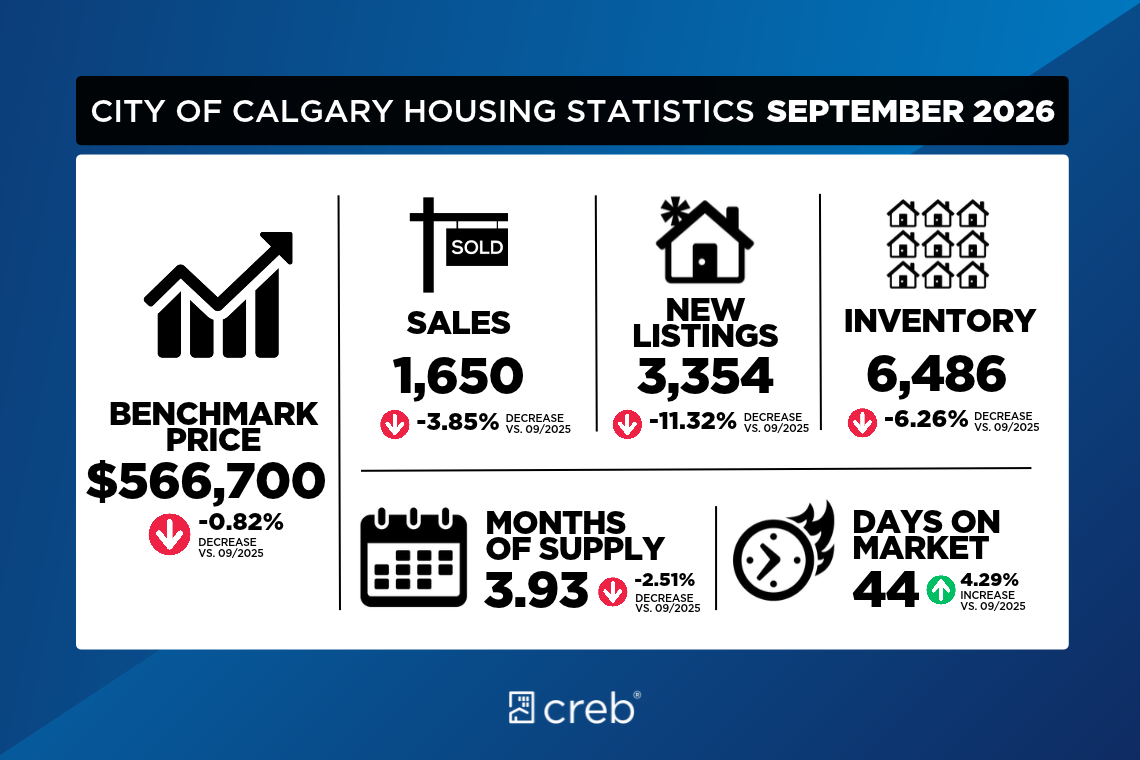
September sales totalled 1,650 units, similar to August and nearly four per cent lower than in September 2025. While September sales typically pull back compared with August, stronger detached home sales helped prevent the typical seasonal pullback.

At the same time, new listings also rose from August, causing the sales-to-new-listings ratio to fall to 49 per cent, leaving inventory levels relatively stable compared with August. Stable sales and inventory levels in September prevented any change in the months of supply compared with August, which remained at just under four months. 

While the overall market is showing higher supply levels compared with sales activity, conditions vary significantly by property type. Detached properties remain in balanced territory, and the monthly boost in new listings supported gains in sales in September. Meanwhile, higher supply levels for apartment and row homes are contributing to buyer market conditions, as demand is spread across more alternatives in the rental and new home markets. 

“The variation in market conditions between property types is related to where the supply was added. The construction boom over the past three years was mostly driven by gains in higher-density sectors, significantly increasing the supply of apartment and row-style homes,” said Ann-Marie Lurie, Chief Economist at the Calgary Real Estate Board (CREB®). “Meanwhile, detached homes did not see the same boost in construction, preventing broad-based supply growth. Thanks to a stronger job market and slower but positive net migration, housing demand has remained strong enough to absorb some of the supply, but not enough to offset the high-density supply added to the market, resulting in a more significant impact on prices for higher-density homes.” 

As the market moves through the fall, it is not unusual to see some unadjusted monthly declines in prices. However, many of these adjustments were seasonal, as seasonally adjusted figures show that prices in September are relatively stable compared with August. The unadjusted residential benchmark price was $566,700, nearly one per cent lower than last year. Most of the price adjustments have occurred in higher-density row and apartment-style units, which have reported year-over-year declines of eight per cent and six per cent in September. Meanwhile, detached prices are one per cent lower than last year, mostly due to declines in the North East, East and North districts.   

Detached

Sales in September reached 896 units, up from August and more than four per cent higher than last year. The improvement in sales was partly due to a boost in new listings in September compared with August, giving consumers more options. With a sales-to-new-listings ratio of 52 per cent and a months of supply at just over three months, conditions remained relatively balanced. However, conditions have varied across the city, with less than three months of supply in the North West, West and South districts, and nearly six months of supply in the North East district. While the overall market is relatively balanced, the unadjusted benchmark price was one per cent lower than last year. The decline was primarily driven by steep pullbacks in the oversupplied North East district. Meanwhile, prices were higher than last year in both the City Centre and West districts.   

Semi-Detached

The year-over-year gain in sales was not enough to offset earlier declines, as year-to-date sales have declined by two per cent for a total of 1,678 sales. The decline in sales matched year-to-date declines in new listings, but a monthly boost in September listings caused the sales-to-new-listings ratio to dip to 45 per cent, contributing to monthly inventory gains and pushing months of supply to nearly four months. While this is a shift from the tighter conditions reported in this sector throughout most of 2026, it is too early to say whether this will continue into the final quarter. While unadjusted prices did trend down in September, much of the decline was in line with typical seasonal behaviour. The unadjusted September benchmark price was $685,200, comparable to levels reported last year at this time.

Row

Sales in September eased compared with August, while new listings rose, causing the sales-to-new-listings ratio to drop to 45 per cent. This also contributed to higher inventory levels compared with both last year and August, resulting in the months of supply rising above four months for the first time since the beginning of the year. Additional competition from new units has weighed on resale activity, as the price spread between new and resale homes remains relatively narrow. The additional supply choice for buyers has also weighed on row prices, but not to the same extent as in the apartment sector. As of September, the unadjusted benchmark price was $412,400, down nearly six per cent from last year. While prices have declined across all districts, the steepest declines, at more than 11 per cent, have occurred in the North East and East districts, while the smallest declines have occurred in the North West, at two per cent. 

Apartment Condominium

Apartment sales improved from August, slowing the year-over-year pace of decline to 14 per cent. New listings also rose over August, with 343 sales and 717 new listings, leaving the sales-to-new-listings ratio at 48 per cent. The monthly gains in sales supported modest reductions in inventory levels and prevented any further increases in the months of supply, which remained just above five months. The excess supply of apartment-style units has weighed on prices throughout most of the year. As of September, the unadjusted benchmark price fell to $291,400, down more than one per cent compared with August and more than eight per cent lower than last September. While some of the monthly decline is seasonal, seasonally adjusted prices continued to decline.  


REGIONAL MARKET FACTS


Airdrie

Sales in Airdrie continued to slow in September, contributing to the year-to-date decline of 13 per cent. Sales slowed across all property types, as increased competition from the new home market and competing markets in Calgary and other surrounding areas are weighing on demand. While sales eased in September, new listings also slowed and inventories trended down compared with August. However, the pullback in sales outpaced the inventory declines and the months of supply rose to four months. Additional supply choice continues to weigh on prices as well. As of September, the unadjusted total residential benchmark price was $505,800, nearly four per cent lower than last year. Prices have eased across each property type, with the largest declines occurring for higher-density homes.

Cochrane

Despite the monthly pullback, sales remained higher than last year, and on a year-to-date basis, sales have increased by nearly six per cent. The rise in sales came with an increase in new listings, with new homes accounting for nearly 30 per cent of this year’s total listings. With 163 new listings and 68 sales, the sales-to-new-listings ratio dropped to 42 per cent in September, the lowest monthly level seen since January. This contributed to higher inventory and pushed the months of supply to five months. Despite this one-month shift, prices improved compared with August and are similar to last year’s levels.  

Okotoks

An increase in new listings compared with sales caused the sales-to-new-listings ratio to drop to 76 per cent in September, still higher than most other areas, but below the ratios of more than 80 per cent reported over the past two months. With 122 units in inventory and 56 sales, conditions remain relatively tight with just over two months of supply. Despite tighter conditions, increased competition from the new home market and competing markets has weighed on prices earlier this year. However, with an unadjusted total residential benchmark price of $606,800 in September, prices are stable relative to last September and are only one per cent lower on a year-to-date basis. 

Chestermere

Sales in September rose, helping to offset some of the gains in new listings. While the sales-to-new-listings ratio remained low at 38 per cent, inventory levels trended down from August and brought the months of supply back below six months. Significant new construction in the area, along with competing supply in Calgary and other surrounding areas, has weighed on prices in Chestermere over the past few months. However, year-to-date prices are only one per cent lower than last year. The unadjusted total residential benchmark price was $690,200 in September, down from August but similar to last year’s levels. 

Read

Calgary Real Estate Update: August 2026

Sales and new listings slow in August

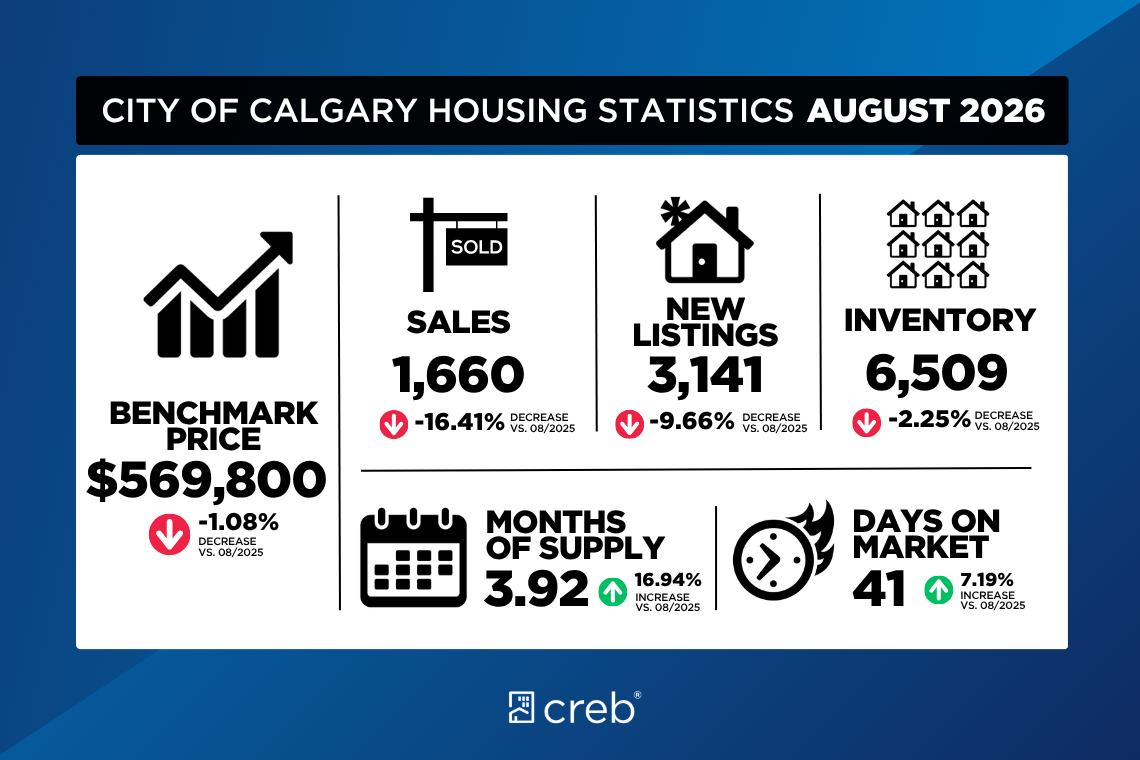
Calgary, Alberta, September 1, 2026 – Consistent with trends throughout most of 2026, both sales activity and the number of new listings coming onto the market have continued to trend down compared with 2025 levels. In August, sales in Calgary were 1,660 units, down 16 per cent compared with last year, while new listings fell by nearly 10 per cent to 3,141 units.

The pullback in sales has not occurred across all price ranges, as homes priced over $1,000,000 have recorded gains over last year. These gains have mostly been driven by detached and semi-detached homes and are also consistent with where most of the supply growth has occurred.

“While sales growth in the upper end of the market was possible thanks to improved supply choice, it also reflects longer-term confidence in our market, as some buyers are not shying away from taking advantage of the available supply,” said Ann-Marie Lurie, Chief Economist at the Calgary Real Estate Board (CREB®). “Meanwhile, we have not seen the same pickup in activity in the lower price ranges, as favourable rental conditions are slowing the transition to ownership.”

Inventory levels in August eased compared with the previous month and the same period last year, at 6,509 units. However, given the pullback in sales, the months of supply pushed up to nearly four months. Also consistent with trends throughout this year, conditions vary significantly by property type, with nearly six months of supply for apartment-style homes compared with over three months of supply for lower-density detached homes.

The relatively balanced conditions in the detached and semi-detached sector have prevented any significant shifts in prices compared with the steady price declines occurring in the oversupplied higher-density segments of the market. As of August, the total residential benchmark price was $569,800, similar to the previous month and one per cent lower than 2025 levels.  

Detached

Gains in higher-priced sales were not enough to offset the pullbacks occurring for homes priced below $1,000,000, as sales fell by 12 per cent to 875 units. At the same time, new listings trended down compared with both July and August 2025 levels, reaching 1,635 units. The steeper decline in sales compared with inventory levels was enough to support a modest monthly gain in inventory levels and drove up the months of supply to over three months. Market balance varies significantly based on price range and location. The months of supply remain below three months in the North West, West, South and South East districts, and above four months in the North and North East districts. The wide range of market balance is also reflected in pricing. Year-over-year gains of over two per cent have occurred in the West and City Centre districts. Meanwhile, price declines were the steepest in the North East at over six per cent. Overall, the benchmark price in August was $744,300, similar to July and down by one per cent compared with last year.

Semi-Detached

Easing sales in August were enough to push year-to-date sales down to 1,516 units, over two per cent lower than last year’s levels. The easing of August sales was not matched by new listings, causing the sales-to-new-listings ratio to fall to 56 per cent. While inventories eased slightly compared with the previous month, they remain nearly five per cent higher than last year. The steeper monthly pullback in sales compared with inventories was enough to push the months of supply above three months, the first time this has happened since January. Despite the shift, conditions remain relatively balanced, and prices have been relatively stable. As of August, the unadjusted benchmark price was $690,500, similar to the previous month and nearly one per cent higher than last year's levels. Price gains in the City Centre, North West and West districts offset pullbacks in other areas, contributing to the annual gain.

Row

Sales continued to ease in August compared with last year, contributing to the year-to-date pullback of 15 per cent. Additional new-home supply, along with more rental product availability, has contributed to some of the pullback in sales activity. Meanwhile, the pullback in new listings has helped prevent any further gains in inventory levels, and the months of supply remained near four months for the second month in a row. Like other sectors, conditions vary depending on location. The months of supply pushed above four months in the City Centre, North East and North districts, while remaining near three months in the West district. Prices have been easing across all districts in the city. The range of decline varied from over 12 per cent in the North East to just over one per cent in the North West district. As of August, the benchmark price was $415,200, down nearly one per cent from July and five per cent lower than levels reported last year at this time.

Apartment Condominium

Apartment-style homes continue to face the most oversupply in the market, with nearly six months of resale supply. More rental supply is weighing on ownership demand from both first-time buyers and investors, which is slowing sales activity while supply levels remain elevated. In August, sales activity continued to fall, contributing to the year-to-date decline of 26 per cent. New listings have also been declining enough to prevent any further inventory gain, but not enough to help the market shift away from buyer-market conditions. Persistently high supply levels relative to demand have weighed on apartment-style prices for the past two years. As of August, the unadjusted benchmark price was $295,400, nearly one per cent lower than the previous month and eight per cent lower than 2025 levels. Prices peaked in August 2024 at $341,300 and currently sit nearly 13 per cent lower than the peak price. 


REGIONAL MARKET FACTS

Airdrie

Sales continued to trend down in August, contributing to the year-to-date decline of 13 per cent. Easing sales have also been met with a seven per cent pullback in new listings over the same period. Throughout most of the year, inventory levels have generally trended higher than last year’s levels and longer-term trends. Over the past few months, we have started to see the pullback in new listings relative to sales cause the sales-to-new-listings ratio to rise, and this has helped prevent any further inventory gains and kept the months of supply below four months. Nonetheless, pressure from competing markets continues to weigh on resale prices. As of August, the unadjusted total residential benchmark price was $508,800, down one per cent from July and over four per cent compared with last year at this time. Steeper price declines are occurring for higher-density apartment-style homes.  
 

Cochrane

Sales improved in August, contributing to the year-to-date gain of over five per cent. Much of the gain in sales has been driven by semi-detached activity. New listings also improved in August compared with last year. The 148 new listings and 94 sales caused the sales-to-new-listings ratio to push above 60 per cent, and inventories edged down compared with the previous month. The boost in sales in August compared with inventory levels caused the months of supply to drop back down to just over three months. Nonetheless, prices still trended down in August. The unadjusted total residential benchmark price eased by nearly one per cent compared with July and is two per cent lower than levels reported last year.  
 

Okotoks

Further declines in new listings likely limited sales activity in August, as the sales-to-new-listings ratio remained elevated at 81 per cent. This contributed to the monthly pullback in inventories, keeping conditions relatively tight with just over two months of supply. Okotoks has struggled with lower-than-average supply levels since 2021, but additional supply choice in competing markets is helping prevent further upward pressure on prices. As of August, the unadjusted total residential benchmark price was $608,400, over one per cent lower compared with July and nearly two per cent lower than last year's levels.
 

Chestermere

The pullback in sales continues to outpace the declines in new listings, as the sales-to-new-listings ratio dropped below 30 per cent in August. This has contributed to elevated inventory levels. While Chestermere is growing, the higher inventory, combined with the pullback in sales, has caused the months of supply to rise, reaching nine months in August. This has continued to weigh on prices, which trended down in August compared with July and currently sit over one per cent lower than 2025 levels.   

Read

Calgary Real Estate Update: July 2026

Price declines driven mostly by apartment condominiums  

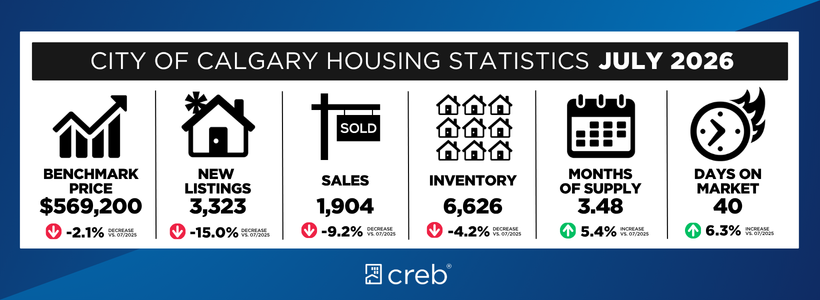
Calgary, Alberta, August 4, 2026 – As we move into the second half of the year, it is not a surprise to see slower market activity. In July, both sales and new listings eased over June levels, declining to 1,904 sales and 3,323 new listings. Sales were nine per cent lower than last year’s levels, while new listings were 15 per cent lower. The adjustment in both sales and new listings caused little change in the sales-to-new-listings ratio, which sat at 57 per cent. 

In July, the unadjusted total residential benchmark price was $569,200, down slightly over June and two per cent lower than levels reported last year. The persistent oversupply of apartment condos is contributing to a steeper price decline of over eight per cent. Meanwhile, at the other end of the spectrum, detached prices have eased by under two per cent compared to last year, mostly driven by adjustments in the North East and North Districts. 

“Several consecutive years of high construction levels and the sudden drop in mostly international migration have contributed to the shift in housing market conditions mostly for higher-density homes, a transition that started in the second half of last year,” said Ann-Marie Lurie, Chief Economist at the Calgary Real Estate Board (CREB®). “While new home construction is slowing, there are over 17,000 apartment-style units under construction. This continues to weigh on rental and higher-density properties, driving price adjustments.”     

While demand has slowed this year, levels remain stronger than those reported during the challenging market conditions experienced from 2015 to 2019. What has shifted significantly is the additional supply choice across the housing spectrum. Total resale inventory levels remained relatively stable compared to both June and July 2025. However, the slower July sales pushed the months of supply up to three and a half months. While the months of supply is rising across all property types, conditions remain mostly balanced in the detached and semi-detached sectors. In the higher-density sectors, the market continues to favour the buyer for apartment-style homes with nearly five months of supply, while row is experiencing some signs of oversupply.

Detached

Sales in July eased to 1,012 units, down nearly two per cent over last year. These numbers have been trending lower throughout most of the year. While slower sales are partly due to changing economic conditions, we have also seen a pullback in the number of new listings. In July, new listings fell to 1,707 units, nine per cent lower than last year, contributing to the year-over-year inventory declines that have persisted since March. The pullback in sales this month outpaced the pullback in inventory levels, causing the months of supply to rise to nearly three months. While this is still in a balanced range, conditions do differ from under two months in the West District to over five months in the North East District. Added competition from the new home market is also weighing on recently built homes listed on the resale market. As of July, the unadjusted detached price in Calgary was $743,900, lower than June and nearly two per cent lower than prices reported last July. While prices have eased over 2025’s peak, it has not erased all the gains reported over the past several years. Price movement has varied significantly across each district. Compared to last year, prices have improved in both City Centre and the West District. The steepest decline occurred in the North East at nearly six per cent. 

Semi-Detached

Despite a typical monthly pullback, sales remained similar to last year, keeping year-to-date levels relatively consistent with 2025. While new listings eased in July, they remain down three per cent so far this year. Throughout most of 2026, conditions have remained relatively balanced, with a sales-to-new-listings ratio remaining near 60 per cent and months of supply below three months. As of July, the unadjusted benchmark price was $691,000, down from June but similar to last year's level. While prices have remained relatively stable for semi-detached homes, there is variation throughout the city. Most sales activity occurred in the City Centre, where year-to-date prices have remained stable compared with 2025. The West District was the only district to record a year-over-year price gain, while the steepest declines occurred in the North East, where buyers' market conditions have emerged. 

Row

For the third consecutive month, row sales have trended down, contributing to a year-to-date decline of 15 per cent. Over the past several months, we have also reported a pullback in new listings, keeping the sales-to-new-listings ratio above 55 per cent.  While inventory levels have also been trending down, they remain elevated based on long-term trends. The steep pullback in sales this month was enough to push the months of supply up to nearly four months. An upward trend in the months of supply over the past few months has prevented any further price increases. In July, the unadjusted benchmark price eased to $418,500, down over the previous month and six per cent lower than last year’s levels. Added competition in the new home market has also weighed on resale row prices. However, like other property types, year-to-date price declines range from 12 per cent in the North East and East Districts to a three per cent decline in the West District. 

Apartment Condominium

Increased rentals and new supply are weighing on ownership demand for resale condos as sales have fallen by nearly 26 per cent so far this year. While new listings have been easing over last year’s levels and are helping to bring down inventory, the 1,999 units available in the resale market are still elevated compared to long-term trends and sales. The combined impact of additional supply and reduced demand has kept the months of supply in a range that has favoured the buyer since the end of spring 2025. The persistent excess supply has placed downward pressure on prices. As of July, the unadjusted benchmark price was $297,600, down over June, over eight per cent lower than last year’s levels and 13 per cent below peak levels reported in 2024. While the rate of decline has ranged across districts, all districts have reported relatively steep adjustments in prices. 


REGIONAL MARKET FACTS

Airdrie

Sales continued to trend down in July compared to 2025, contributing to the year-to-date decline of nearly 14 per cent. However, new listings have also been easing, helping to push the sales-to-new-listings ratio back above 55 per cent in July. While this did little to cause a shift in inventory, the months of supply eased back below four months. Should this trend continue, it will help to support a more balanced state in the Airdrie market. Nonetheless, supply choice in the resale market along with added competition coming from both the new home market in Airdrie and supply choice in Calgary are weighing on prices. Detached prices in July eased to $603,100, four per cent lower than last year’s levels. This decline has outpaced Calgary’s, and now the price spread between Calgary and Airdrie is returning to levels that are more consistent with historical norms.  

Cochrane

While sales have eased for two months in a row, year-to-date, they remain higher than levels reported in 2025. This was partly possible due to gains in new listings, which have raised inventory over last year’s levels. Much of the inventory growth was driven by higher-density homes. In July, the months of supply pushed above four months, and the sales-to-new-listings ratio dropped to 46 per cent. This represents a shift from earlier in the year, and if it persists, it could have further implications for prices. Overall, the unadjusted detached benchmark price was $659,400 in July, down over June and nearly four per cent lower than last year. Like other markets, the added competition from new home products and competing markets is weighing on resale prices.

Okotoks

With 78 new listings and 70 sales in July, the sales-to-new-listings ratio rose to 90 per cent, causing inventories to trend down over the previous month. Supply has improved over the low levels that have persisted over the previous five years but remain below long-term trends and have kept the months of supply relatively low at two months. However, benchmark prices have continued to trend down, likely due to the increased competition coming from the new home sector and new community developments occurring in the south end of Calgary. As of July, the unadjusted detached benchmark price eased to $695,700, over two per cent lower than prices reported last July. 

Chestermere

Year-to-date sales in Chestermere have reached 333 units, 18 per cent lower than last year. The decline in sales has not matched the decline in new listings, keeping the sales-to-new-listings ratio relatively low at 36 per cent. This has resulted in relatively persistent inventory gains, driving up months of supply, which pushed near seven months in July. Additional supply choice in the resale market, competing new home market and supply in Calgary has weighed on prices in Chestermere. As of July, the unadjusted detached benchmark price was $771,900, down over June and nearly five per cent lower than prices reported in July of 2025. 

Read

Calgary Real Estate Update: June 2026

High-density supply impacts apartment condominium prices

Calgary, Alberta, July 2, 2026 – June sales in Calgary improved over May, reaching 2,197 units. Despite the monthly gains, sales were nearly four per cent lower than last year and just below the long-term average for June, largely due to pullbacks in apartment-style units. While sales are down across most price ranges so far this year, there have been gains in both the highest price ranges and the most affordable ranges across most property types. 

“The easing of demand for resale homes does not come as a surprise given the recent decline in migration, which is impacting both rental and ownership demand for higher-density homes. The bigger change in our market relates to inventory, which has been on the rise in the rental, resale and new-home markets following several consecutive years of record-high housing starts,” said Ann-Marie Lurie, Chief Economist at the Calgary Real Estate Board (CREB®). “Inventory growth has mostly occurred in high-density homes, resulting in buyer’s market conditions and steep price adjustments for condominium apartments. While it will take time to absorb the high-density supply, detached supply growth has been limited and some districts are reporting record-high prices.” 

New listings are starting to pull back compared with 2025 and the sales-to-new-listings ratio rose to 56 per cent. This has slowed the pace of inventory growth in the market and kept the months of supply at just over three months. This is considered a balanced range in the city, but conditions vary across property types. The apartment condominium sector is experiencing buyer’s market conditions, with the months of supply at nearly five months and a sales-to-new-listings ratio of 45 per cent. 

The range of conditions is also impacting prices. In June, the unadjusted benchmark price was $572,500, up over the previous month and two per cent below levels reported last June. However, apartment-style properties have reported an annual decline nearing nine per cent, leaving condominium prices in June at $299,000. Meanwhile, the benchmark price for a detached home rose over the previous month, reaching $750,500, one per cent below last year’s level, with most of the adjustments driven by specific pockets of the market.

Detached

Sales activity in June reached 1,202 units, in line with last year’s levels, as gains for homes priced over $1,000,000 and under $600,000 offset pullbacks in the other price ranges. Sales growth in these segments was partly supported by increases in new listings and inventory growth in those same ranges. While overall inventories have remained in line with last year’s levels and conditions remain relatively balanced, the pullback in new listings this month caused the sales-to-new-listings ratio to rise to 60 per cent. Despite balanced conditions citywide, the North East and East districts are experiencing excess supply relative to demand. In these districts, the months of supply is elevated and the sales-to-new-listings ratio is below 50 per cent. Relatively balanced conditions have supported monthly price gains since the start of the year. It is only the City Centre and West districts that have recorded enough of these gains to reach record-high prices in June. The West district, which has also been experiencing seller’s market conditions, has reported the strongest year-over-year growth at nearly four per cent. Meanwhile, buyer’s market conditions in the North East are contributing to price declines nearing seven per cent. As of June, the citywide benchmark price was $750,500, up over the previous month and over one per cent lower than last year.

Semi-Detached

Improving sales in June were nearly enough to offset earlier pullbacks, leaving year-to-date sales down by only one per cent compared with last year. The 234 sales in June were met with 363 new listings, pushing the sales-to-new-listings ratio back above 60 per cent and slowing the pace of inventory growth compared with earlier in the year. With two and a half months of supply, conditions remained relatively balanced and continued to support stable prices. In June, the unadjusted benchmark was $694,600, up over the previous month and similar to levels reported last June. Similar to the detached sector, price movements vary significantly across the city. Compared with last year, prices have improved in the North West, West and City Centre districts, reaching a new record high in June while the steepest declines occurred in the North East at nearly six per cent.

Row

June saw a pullback in both sales and new listings activity, causing the sales-to-new-listings ratio to rise to 55 per cent. This prevented any further gains in inventory levels, which remain above long-term trends. With 1,152 units in inventory and 338 sales this month, the months of supply sat at nearly three and a half months. While this is higher than both the detached and semi-detached sectors, it remains within the upper end of a balanced range. Additional supply choice has led to price adjustments. Year-over-year declines have occurred across all districts, ranging from two per cent in the South to 10 per cent in both the North East and East districts. Unadjusted prices improved in June over the previous month, as gains in the City Centre, North West and South districts offset pullbacks in the East, North East, West and South East districts.

Apartment Condominium

Sales in June continued to fall compared with last year, causing year-to-date sales to decline by 26 per cent to a total of 2,260 units. While new listings eased this month, the 931 new listings and 423 sales kept the sales-to-new-listings ratio at 45 per cent. In June, inventory levels reached 2,076 units – slightly lower than last June’s level but more than 24 per cent above typical inventory levels. This kept the months of supply at around five months, contributing to further price adjustments. In June, the unadjusted benchmark price was $299,000, down over the previous month and nearly nine per cent lower than last year. Prices have declined across all districts, with decreases exceeding 14 per cent in the North East and East districts. The smallest decline occurred in the North West district at seven and a half per cent.


REGIONAL MARKET FACTS

Airdrie

Sales in June continued to ease compared with last year, contributing to a year-to-date decline of 14 per cent. New listings also eased this month, but with a steeper pullback in sales, the sales-to-new-listings ratio fell to 47 per cent. June inventory levels rose to 538 units. Higher inventory and slower sales pushed the months of supply above four months. Elevated levels of supply in Airdrie, along with increased competition from neighbouring and new home markets, have weighed on resale prices. In June, the unadjusted benchmark price was $516,900, up slightly over the previous month but nearly four per cent lower than last year. Prices declined across all property types, with larger decreases observed in higher-density homes.

Cochrane

Easing sales in June did not offset earlier gains, as year-to-date sales of 569 units were slightly higher than last year’s levels. Meanwhile, new listings also eased, keeping the sales-to-new-listings ratio above 60 per cent. Inventory levels eased slightly from the previous month, reaching 323 units in June. The monthly pullback in inventory did not outpace the pullback in sales, causing the months of supply to push above three months. Despite the increase, relatively tight conditions have supported monthly price gains over the past five months. As of June, the unadjusted benchmark price was $580,200, less than two per cent lower than prices reported at this time last year.

Okotoks

With 89 new listings and 70 sales in June, the sales-to-new-listings ratio rose to 79 per cent, preventing any further monthly gains in inventory levels. Inventory has improved compared with last year but remains below long-term trends, especially for detached homes. While conditions are more balanced compared to last year, lower supply levels have helped keep prices stable. In June, the unadjusted benchmark price was $618,600, similar to the previous month and less than two per cent lower than last June.

Read
Data is supplied by Pillar 9™ MLS® System. Pillar 9™ is the owner of the copyright in its MLS®System. Data is deemed reliable but is not guaranteed accurate by Pillar 9™.
The trademarks MLS®, Multiple Listing Service® and the associated logos are owned by The Canadian Real Estate Association (CREA) and identify the quality of services provided by real estate professionals who are members of CREA. Used under license.